
Your Second Time in Japan: 5 Experiences Beyond Tokyo and Kyoto
You've already navigated Shinjuku at rush hour. You've watched the sun rise over Fushimi Inari before the crowds arrived. You came home from your first trip knowing Japan had more to offer — much more. So now you're planning your second time in Japan, and the question is: what do you do when the obvious answers no longer feel like enough?
The good news is that Japan's depth is almost unfair. The country rewards repeat visitors with layers that first-timers simply can't access — quieter towns, slower rhythms, and experiences that feel genuinely personal rather than scripted for tourism. Here are five ways to go deeper.
1. Swap the Golden Route for the San'in Coast and Tottori
Most Western travelers treat Japan as a corridor between Tokyo and Kyoto. The San'in region — the Japan Sea-facing side of Honshu — sees a fraction of that traffic, and it shows in the best possible way.
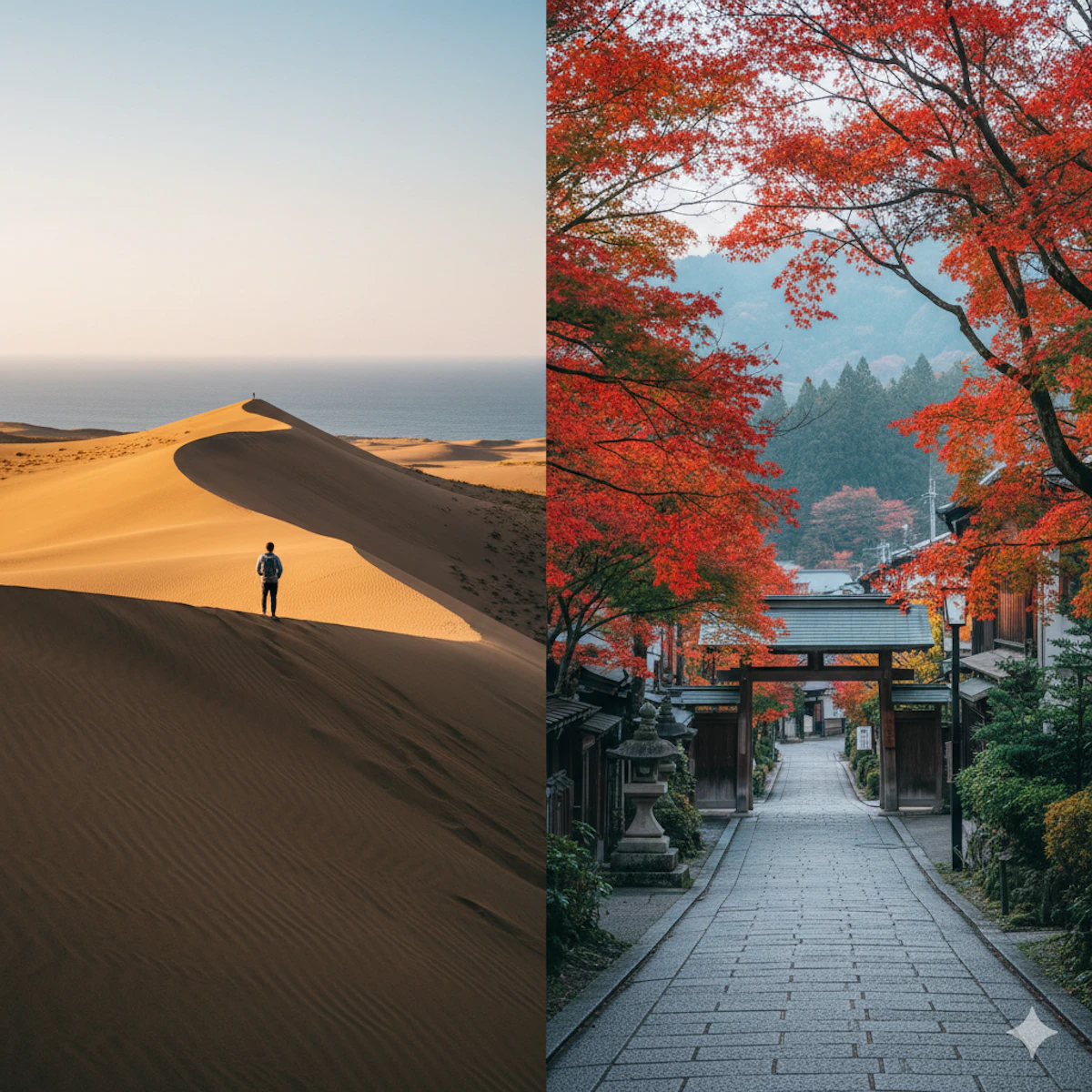
Tottori's sand dunes are the kind of thing you don't expect to find in Japan: a coastal dune system about 16 kilometers long that feel more Sahara than Japan. (Google Maps) The prefecture is also known for its winter crab (matsuba-gani, in season roughly from November to March).
From Tottori, follow the coast west to Izumo, home to Izumo Taisha (Google Maps), one of Japan's oldest and most important shrines. It is especially interesting in the tenth month of the old calendar (kamiarizuki), when gods from across Japan are said to gather here. In 2026 the festivals run from about 18 to 25 November.
2. Stay in a Machiya in Kanazawa — and Actually Slow Down
If Kyoto represents old Japan polished for international visitors, Kanazawa is what Kyoto might feel like if fewer people had discovered it. The city survived World War II with its historic districts largely intact, meaning you can walk through Higashi Chaya (the geisha quarter) or Kazuemachi without feeling like you're inside a theme park.
For repeat visitors, the most transformative choice is accommodation: machiya stays — traditional wooden townhouses converted into private guesthouses — are available in Kanazawa. Waking up inside a 100-year-old lattice-windowed building, making pour-over coffee in a converted doma earthen floor kitchen, changes your relationship with a place entirely.
Beyond aesthetics, Kanazawa is a working city with serious food credentials. Omicho Market (Google Maps) has served the city for about 300 years. Book a local cooking class here — several operators take you through the market to select ingredients, then teach you to prepare regional dishes like jibuni (a simmered duck dish from Kanazawa) in a traditional kitchen setting.
3. The Iya Valley: One of Japan's Last Genuinely Remote Corners
Deciding on second time in Japan what to do often comes down to a simple question: do you want comfort or experience? The Iya Valley in Tokushima Prefecture, Shikoku, answers that question firmly on the side of experience.
Getting there requires intention — it's a drive of around two hours into the mountains from Tokushima city, along roads that narrow to single-lane passages above river gorges. That friction is the point. The valley's famous vine bridges (kazurabashi, Google Maps) are made from shirakuchi-kazura, a wild hardy kiwi vine, and are rebuilt every three years. Thatched-roof farmhouses cling to the steep slopes of the valley's mountain villages.
Several properties in Iya offer stays in restored farmhouses with an irori (central hearth) and meals made from local ingredients. Check each property for what activities it offers.
4. Tohoku: The North That Most Visitors Miss Entirely
Tohoku — the six prefectures of northern Honshu — remains the clearest example of authentic Japan travel experiences hiding in plain sight. The bullet train from Tokyo reaches Sendai in about 1.5 hours, yet Tohoku receives far fewer international visitors than Kyoto.
What you find here:
- Aomori's Nebuta Festival (early August) can be seen year-round at the Nebuta Museum Wa Rasse (Google Maps), a one-minute walk from Aomori Station, where the enormous illuminated floats are displayed up close. Check the official site for hours and any hands-on programs.
- Yamagata's sake breweries include Dewazakura in Tendo (Google Maps), which runs guided brewery tours with tasting (around 90 minutes; advance reservation required, check the official site for dates and the current fee).
- Matsushima (Google Maps) is one of the Three Views of Japan (Nihon Sankei) and is worth the reputation. The bay is also known for oysters, and local oyster huts serve them fresh in season.
5. Matsumoto and the Japanese Alps: Where Japan Beyond Tokyo and Kyoto Gets Physically Dramatic
There is a version of second time in Japan what to do that involves putting your body in Japan's geography rather than just its culture. The Japanese Alps — accessible from Matsumoto in Nagano — make this possible.
Matsumoto itself earns a full day: its castle (Google Maps) is a National Treasure with an original keep — the oldest surviving five-tier, six-floor keep in Japan (unlike the reconstructed versions in Osaka and Hiroshima).
But the reason serious Japan travelers base themselves in Matsumoto is access. The Kamikochi valley (Google Maps), reachable by bus from Matsumoto, is one of the most spectacular landscapes in the country, with the Azusa River and the Northern Alps rising behind it. The valley is closed to private cars, and the season runs from mid-April to 15 November (17 April to 15 November in 2026); it is closed for the winter after that.
For lesser known Japan destinations in the Alps region, the Azumino area just north of Matsumoto is known for wasabi grown in cold spring water, such as at the Daio Wasabi Farm (Google Maps).
Planning Your Second Japan Trip: A Few Practical Principles
The travelers who get the most from a second visit to Japan tend to share a few habits:
Slow down the geography. First-timers cover five cities in ten days. On a return trip, two or three regions covered deeply will leave you with more than a five-city sprint.
Book the participatory experiences early. Sake brewery tours, cooking classes, farm experiences, and machiya stays in smaller towns often have limited availability — especially the highest-quality operators who limit group sizes deliberately. Book these before your flights.
Use local transit, not just the JR Pass. The JR Pass is efficient for the main trunk lines, but many of the off the beaten path Japan destinations above require local buses, private rail lines, or rental cars. Budget time and a modest additional amount for this flexibility.
Talk to your accommodation hosts. In smaller towns and ryokan, the owner or innkeeper frequently has connections to experiences that don't exist online — the family sake brewery that does informal tours for guests they like, the elderly farmer who will let you join her market morning. These happen through relationships, and your host is your best introduction.
Japan's lesser known destinations aren't hidden because they're inferior. They're quieter because the infrastructure that feeds mass tourism hasn't reached them yet — and in most cases, the people who live there prefer it that way. As a repeat visitor, you're in a position to experience that Japan, respectfully and on its own terms.
Wander shows you experiences like these in short videos filmed on location, so you can see a place before you plan around it.